Key Exchange (KEX) is the first step in organising an SSH connection. It permits the client and server to securely agree on a shared secret key with out ever sending the important thing over the community. The /etc/crypto-policies/state/CURRENT.pol file lists all settings within the currently utilized system-wide cryptographic coverage after wildcard expansion.
Security
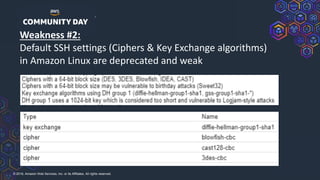
If your vulnerability stories have flagged these, you should explicitly remove them from your crypto-policy setup. From our findings, after making use of the SSH hardening insurance policies, a re-analysis of the SSH algorithm negotiation above exhibits that only robust algorithms are actually being supplied. Particularly, we not see weak algorithms corresponding to hmac-sha1 or diffie-hellman-group14-sha1 within the listing. Instead, solely safe algorithms like curve25519-sha256, email protected, and hmac-sha2-256 are negotiated. As you possibly can see, the weak algorithms that had been present before hardening have been successfully removed.
Deprecated Ssh Cryptographic Settings
While up to now we did not disable algorithms in a constant means (different purposes utilized totally different policies), today we’ve a system-wide coverage which is adopted by all RHEL crypto core parts. These policies allow us to persistently deal with and deprecate algorithms system-wide. Choices about policy contents are based on paperwork like RFC 7457 which gives a list of assaults taking advantage of legacy crypto algorithms. You also can remove a symlink associated to your application from the /etc/crypto-policies/back-ends directory and replace it together with your personalized cryptographic settings. This configuration prevents the use of system-wide cryptographic policies for functions that use the excluded back end. These ciphersuites and protocols are available however disabled in all crypto coverage ranges.

Set Up Zabbix Server On Rocky Linux
Subsequently, to make sure weak cryptographic algorithms are literally disabled, it’s finest apply to harden them at the crypto-policy degree. You can customise https://getbestdrone.com/tag/software/ cryptographic settings utilized by your utility ideally by configuring supported cipher suites and protocols directly within the utility. Purple Hat continuously adjusts all coverage levels so that each one libraries present safe defaults, except when utilizing the LEGACY policy. Even though the LEGACY profile does not present safe defaults, it doesn’t include any algorithms which may be easily exploitable.
The concept of scoped policies permits enabling different sets of algorithms for different again ends. You can limit every configuration directive to particular protocols, libraries, or companies. Use this process to adjust the set of enabled cryptographic algorithms or protocols.
In specific, the NO-SHA1 module nonetheless allows using SHA-1 with hash-based message authentication codes (HMAC). This is as a result of HMAC safety properties do not rely on the collision resistance of the corresponding hash perform, and due to this fact the latest assaults on SHA-1 have a significantly decrease impact on using SHA-1 for HMAC. Let’s configure an OpenSSH server to solely offer the AES 256-bit variant of symmetric ciphers for an ssh connection. To apply the change restart the sshd service and verify the ciphers then test you’ll have the ability to still login by opening a brand new session.
- As A Outcome Of the SHA-1 hash function has an inherently weak design, and advancing cryptanalysis has made it vulnerable to assaults, RHEL eight doesn’t use SHA-1 by default.
- Right Here are the configuration settings that management the cryptographic algorithms choice.
- TheCVSS environmental score is specific to each customer’s setting andshould be defined by the client to realize a last scoring.
- Also, create the following crypto policy module to disable the Diffie-Hellman Group14 key change algorithms (diffie-hellman-group14 and diffie-hellman-group14-sha1) on RHEL 8.
This file dictates which algorithms the server really uses, so it’s essentially the most relevant place to examine and repair weak configurations. Nonetheless, 3DES ciphers weren’t found as you’ll have the ability to see there aren’t any 3des-cbc or similar 3DES algorithms in our ciphers list, indicating this part of the Rapid7 report seems to be a false optimistic for our system. Red Hat Enterprise Linux contains several cryptographic components whose safety doesn’t remain constant over time. Algorithms similar to (cryptographic) hashing and encryption usually have a lifetime after which they are thought of either too dangerous to make use of or plainly insecure. That means we have to part out those algorithms from the default settings, or fully disable them in the occasion that they can’t be used securely in any respect.
An HMAC (Hash-based MAC) is a standard sort of MAC that makes use of a cryptographic hash function (like SHA-1 or SHA-2) combined with a shared secret key. Legacy techniques or software does not have to assist the more trendy and stricter algorithms and protocols enforced by the FUTURE policy. For example, older techniques might not help TLS 1.three or bigger key sizes. The fips-mode-setup device, which switches the RHEL system into FIPS mode, makes use of this policy internally.
After applying crypto-policy changes or customizing your SSH configuration, it’s essential to confirm that the weak algorithms are no longer accepted by the server. With Out proper validation, weak settings could silently persist, particularly if coverage modules or defaults weren’t applied as intended. Pink Hat permits directors to increase or modify system-wide cryptographic settings via the use of customized policy modules. These modules are simple textual content recordsdata that let you allow or disable specific cryptographic algorithms, tailored to your environment’s security necessities. These flagged vulnerabilities remained despite explicitly configuring secure settings in /etc/ssh/sshd_config across our Red Hat techniques (RHEL 7, 8, and 9).
TheCVSS environmental rating is specific to every customer’s environment andshould be outlined by the shopper to achieve a ultimate scoring. The version of the firmware must be checked after the replace toconfirm successful installation.
